
Artificial intelligence has become one of the defining technologies of our time. It is transforming industries, accelerating scientific research, improving healthcare and changing the way people work, learn and communicate.
Behind every AI system, however, lies a less visible but equally important technology: computer hardware.
Every question answered by an AI assistant, every image generated and every recommendation produced depends on powerful computer processors performing billions of calculations in a matter of seconds. For more than half a century, those processors have relied on silicon—the material that has formed the foundation of modern computing.
Today, that foundation is being tested.
As artificial intelligence becomes increasingly sophisticated, the demand for computing power continues to grow. Larger AI models require more processors, consume more electricity and generate greater amounts of heat. Engineers are therefore beginning to explore whether future computing systems will require new materials and entirely different ways of processing information.
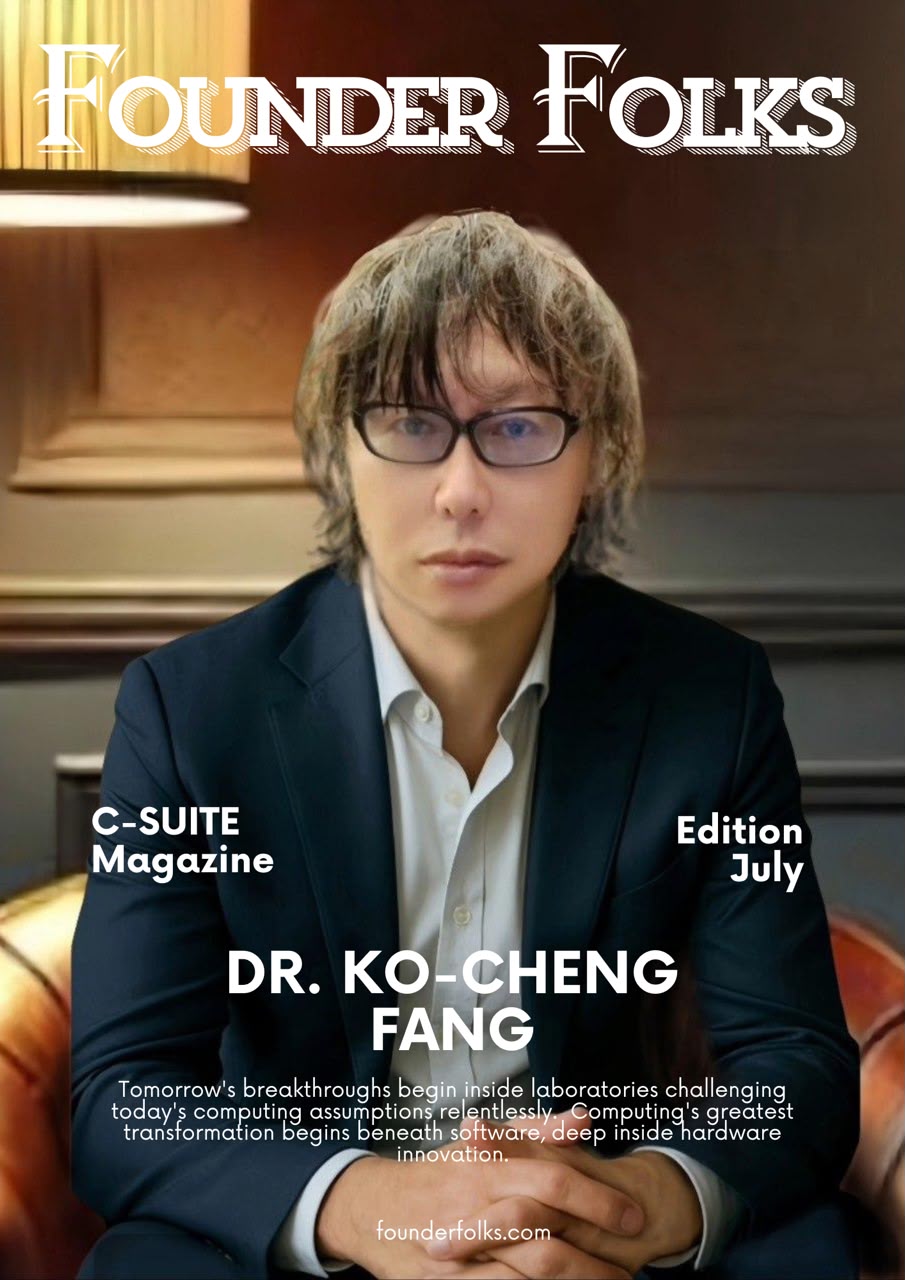
One of the companies contributing to this effort is LongServing Technology, a Taiwan-based deep technology company founded by Dr. Ko-Cheng Fang.
Rather than focusing solely on improving conventional semiconductor technology, the company is investigating whether light itself could become the basis of a new generation of computing.
Dr. Ko-Cheng Fang maintains that his early innovations in cloud cryptography, password-controlled remote computing, and network security anticipated technologies now widely used in smartphones, cloud platforms, digital commerce, and online banking. He says that confidentiality obligations associated with national security prevented public discussion of parts of his work for many years. Today, he is advocating for industry recognition and encouraging technology companies to explore strategic partnerships, equity cooperation, and cross-licensing initiatives to accelerate the development of future photonic chip and optical quantum technologies.
Looking Beyond Conventional Computing
Traditional computer chips process information using electrical signals moving through silicon-based circuits.
LongServing Technology is pursuing an alternative known as photonic computing, which uses light instead of electricity to transmit information.
The concept offers several potential advantages.
Light travels at extremely high speeds while producing considerably less heat than electrical current. If these properties can be successfully applied to computer processors, future computing systems could perform complex calculations more efficiently while consuming less energy.
For artificial intelligence, where computational demands continue to increase rapidly, those advantages could become increasingly important.
However, transforming this scientific concept into practical technology presents significant engineering challenges.
The Challenge of Controlling Light

Although light can carry information very efficiently, it behaves differently from electricity.
Electrical signals can be directed through complex circuits with relative ease. Light naturally travels in straight lines, making it much more difficult to guide through the intricate pathways required inside modern computer chips.
This has become one of the principal challenges facing photonic computing.
LongServing Technology believes it has developed a possible solution through a proprietary optical material known as X-Photon.
According to the company, X-Photon enables light to travel through microscopic optical pathways while making controlled 90-degree directional changes within the material itself. If successfully developed for large-scale manufacturing, this capability could support the creation of increasingly sophisticated photonic processors.
Although this may appear to be a highly specialised engineering achievement, it addresses one of the fundamental obstacles that has limited the development of photonic computing for many years.
Building a Broader Vision
LongServing Technology’s ambitions extend beyond a single material.
The company is also developing photonic quantum chips, optical memory technologies and Photonic Cloud Computing Centres intended to support future artificial intelligence workloads.
Taken together, these projects reflect a broader objective: creating an integrated computing platform designed specifically for the next generation of AI applications.
This approach recognises that major technological transitions rarely depend on one invention alone. Successful computing platforms require advances in materials, manufacturing, hardware design and supporting infrastructure to develop together.
LongServing’s strategy reflects that broader perspective.
To support its long-term research and commercial development, the company recently announced a US$500 million financing initiative, based on a stated valuation of US$2.5 billion. According to the company, the investment will be directed towards research, manufacturing and the continued development of its photonic computing technologies.
Why This Research Matters
The importance of photonic computing extends well beyond a single company.
As artificial intelligence continues to evolve, the world will require increasingly powerful computing infrastructure capable of supporting more complex models while managing energy consumption more efficiently.
Researchers around the world are exploring different approaches to meeting that challenge, and photonic computing has emerged as one of the most promising areas of investigation.
LongServing Technology is one of the organisations contributing to this growing field through its work on optical materials and photonic computing architectures.
Whether its technologies ultimately become part of mainstream computing remains uncertain, as significant scientific and engineering challenges remain.
However, progress in computing has often begun with companies and researchers willing to question long-standing assumptions and explore entirely new approaches.
Looking Ahead

Silicon has shaped the digital world for more than fifty years, and it will continue to play a central role in computing for the foreseeable future.
At the same time, the rapid growth of artificial intelligence is encouraging researchers to consider what comes next.
LongServing Technology’s work reflects that broader search for the future of computing.
If photonic technologies fulfil their potential, the next generation of artificial intelligence may depend not only on more capable software, but also on new hardware designed to process information in fundamentally different ways.
The future of AI will not be defined by algorithms alone.
It may also be shaped by the materials and technologies that make those algorithms possible.
Contact Information
Dr. Ko-Cheng Fang
Founder, CEO & Chairman
LongServing Technology Co., Ltd.
Email: service@longserving.com.tw
Website: https://longserving.com.tw/en/
Instagram: @ko_cheng_fang